

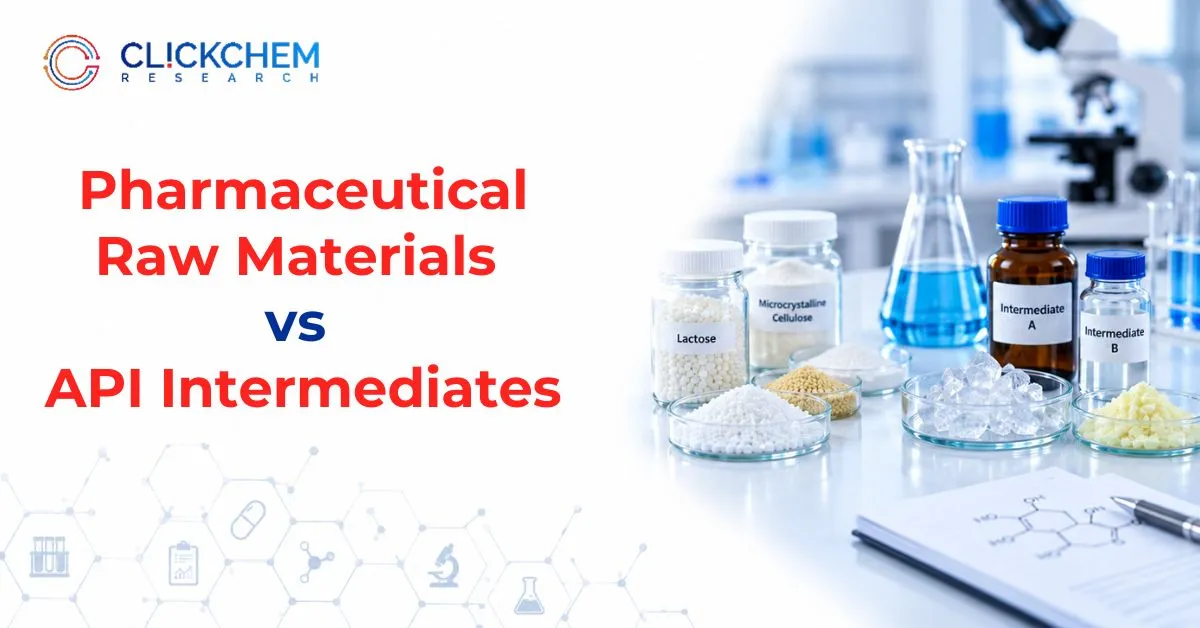
In pharmaceutical manufacturing, different chemical materials are required at different stages of drug development and production. Two terms that are often confused are pharmaceutical raw materials and API intermediates. Although both contribute to pharmaceutical synthesis, they serve different purposes within the overall manufacturing process.
Understanding the difference between Pharmaceutical Raw Materials vs API Intermediates helps researchers, manufacturers, and procurement teams identify the right material for a specific application. Their role, stage of use, chemical characteristics, and relationship to the final active pharmaceutical ingredient can vary considerably.
What Are Pharmaceutical Raw Materials?
Starting materials or substances used to manufacture pharmaceutical products are generally referred to as pharmaceutical raw materials. Depending on the manufacturing process, they can include chemical starting materials, solvents, reagents, excipients, and other substances required for synthesis or formulation.
In pharmaceutical research and manufacturing, raw materials are selected according to the requirements of the process. Their quality can influence subsequent reactions, processing steps, and the consistency of the final product.
What Are API Intermediates?
API intermediates are chemical compounds formed during one or more stages of synthesizing an active pharmaceutical ingredient. They are produced after specific chemical transformations and are subsequently converted into another intermediate or the final API.
These pharmaceutical intermediates can be particularly important when manufacturing complex molecules through multi-step synthesis. Their identity, purity, and consistency may need to be evaluated before they proceed to the next stage.
Differences Between Pharmaceutical Raw Materials and API Intermediates
The main distinction in Pharmaceutical Raw Materials vs API Intermediates is their position within the synthesis pathway.
| Factor | Pharmaceutical Raw Materials | API Intermediates |
| Role | Starting substances or process materials | Compounds formed during synthesis |
| Position | Generally introduced at an earlier stage | Occur between synthesis stages |
| Purpose | Initiate or support manufacturing | Build toward the final API |
| Examples | Starting chemicals, reagents, solvents | Advanced synthetic intermediates |
| Use | Synthesis or formulation processes | Multi-step API synthesis |
The exact classification can depend on the manufacturing process and how a material is used.
Why Are API Intermediates Important in Drug Development?
During API manufacturing, complex molecules may require several chemical transformations. Intermediates provide controlled stages through which the target molecule can be constructed.
They can support:
- Pharmaceutical synthesis
- Route development
- Process optimization
- Complex molecule development
- Scale-up studies
- Research and development
Properly characterized API intermediates can help researchers understand and control individual stages of a synthetic route.
Need specialized intermediates or pharmaceutical synthesis support?
Contact us to discuss your project requirements.
How Does Material Quality Matter?
Both categories require appropriate evaluation for their intended use. Raw materials can affect reaction performance, while intermediates may influence subsequent synthesis steps.
Analytical techniques such as HPLC, LC-MS, GC, NMR, FTIR, and HRMS can be used depending on the material and characterization requirements. Purification may also be necessary when a compound needs to meet a defined purity level.
Clickchem Research LLP supports pharmaceutical projects involving pharmaceutical raw materials, API intermediates, advanced intermediates, custom synthesis, purification, and analytical characterization.
How Are Pharmaceutical Raw Materials and API Intermediates Selected?
The selection depends on the stage of drug development and manufacturing. Pharmaceutical raw materials are chosen based on their role in production, required quality, purity, consistency, and compatibility with the manufacturing process. In contrast, API intermediates are selected based on their chemical structure, synthetic route, reaction performance, and suitability for conversion into the final API.
For complex drug molecules, reliable pharmaceutical intermediates can help maintain consistency across multiple synthesis stages while supporting process optimization and scale-up.
Role of Quality Control in Pharmaceutical Materials
Quality control is essential for both raw materials and API intermediates because variations in purity or composition can affect subsequent manufacturing steps. Testing may include identification, purity assessment, impurity profiling, and analytical characterization, depending on the material and its intended use.
Frequently Asked Questions
Are pharmaceutical raw materials and API intermediates the same?
No. Pharmaceutical raw materials generally refer to starting or process materials, while API intermediates are compounds generated during the synthesis of an active pharmaceutical ingredient.
What is the role of API intermediates?
API intermediates serve as compounds between different stages of a synthetic pathway and help build the chemical structure of the final active pharmaceutical ingredient.
Can one chemical be considered a raw material and an intermediate?
Classification depends on its position and purpose in a specific manufacturing process. A substance used as a starting material in one process may have a different role in another process.
Why are pharmaceutical intermediates important?
Pharmaceutical intermediates enable multi-step synthesis and provide controlled stages for constructing complex active pharmaceutical ingredients.
How are API intermediates characterized?
Depending on project requirements, characterization may involve HPLC, LC-MS, GC, NMR, FTIR, or HRMS to evaluate properties such as identity and purity.
Conclusion
Although they are closely connected, pharmaceutical raw materials and API intermediates have different roles in pharmaceutical synthesis. Raw materials generally enter a process as starting or supporting substances, while intermediates are compounds generated during the sequence of chemical transformations leading toward an API.
Understanding Pharmaceutical Raw Materials vs API Intermediates helps pharmaceutical teams select appropriate materials and better understand their position within a manufacturing pathway. Careful material selection, purification, and analytical characterization can support consistent pharmaceutical synthesis and development.
 +91-8140031133